
Cart 0

“I am a canvas of my experiences; my story is etched in lines and shading, and you can read it on my arms, my legs, my shoulders, and my stomach.”- said the famous artist and businesswoman Kat Von D. Although tattoos have become fashionable in recent years, their history and practice dates back to ancient times. From 28 March to 28 July 2024, MUDEC Museum (Museo delle Culture di Milano) is hosting the exhibition “Tatuaggio: storie dal Mediterraneo,” curated by Luisa Gnecchi Ruscone and Guido Guerzoni in collaboration with Jurate Francesca Piacenti.
The exhibition traces the origins of tattooing from Ancient times to the present day, mainly focusing on the Mediterranean area while also displaying non-European materials that facilitate the comparison of a global phenomenon. Through original artifacts, reproductions, photographs, videos, and installations, visitors can explore over 7,000 years of history and discover tattoos’ diverse forms and meanings across cultures.

As the great author of “White Fang,” Jack London said, “Show me a man with a tattoo, and I’ll show you a man with an interesting past.” Over millennia, tattoos have evolved in form, meaning, and function, but they always tell the story of a man, a tribe, or a culture, using the human body as a unique canvas.
In North Africa, tattoos have a long tradition that dates back to prehistoric times. Civilizations such as ancient Egypt practiced tattooing, often infusing it with religious or spiritual significance. Evidence of tattooed mummies suggests that tattooing was common in Egypt as early as 2000 BC.

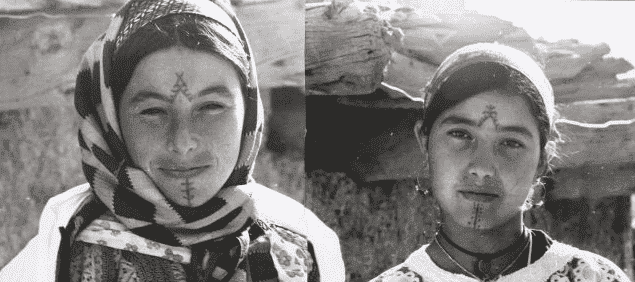
For the Amazigh, an indigenous ethnic group primarily from North African regions like Morocco, Algeria, Tunisia, Libya, and Mauritania, tattooing aided nomadic tribes in distinguishing members of different groups. Symbols within the tattoos served as a unifying force, deeply rooted in each group’s history and purpose. They told the stories of tribes, tied women to their land, and conveyed familial ties. Amazigh (Berber) women tattooed their faces, feet, arms, and other body parts for beauty, health, and protection. However, as the region’s cultural dynamics and traditions changed over time due to globalization and the influence of Islam in society, the ancient traditions began disappearing.
Within their lifetimes, elderly amazigh women witnessed an unexpected transformation within the North African region when their tattoos, which once made them sought after, became a source of shame. With a rise in Arabic literacy specifically, it became more widely known that tattoos are considered haram or religiously prohibited in Islam. “I did it because all the girls my age were tattooed. At that time, we were very young; even if we didn’t have extensive knowledge about the religion, our thoughts were far from committing a sin,” said Fatma Haddad, 80, who was tattooed at age 18 by a local woman. She is now regretting her decision to get a facial tattoo and has given away her silver jewelry to ask for forgiveness from God after being told by religious people that it was a sin.

In Europe, tattooing also experienced periods of acceptance and taboo. The ancient Greeks and Romans used tattoos to mark slaves and criminals, serving as forms of punishment or social identification. With the spread of Christianity in Europe from the 4th century onwards, attitudes towards tattooing shifted. The early Christian period saw some acceptance of tattoos among converted individuals, often using Christian symbols like crosses. However, this practice declined during the Middle Ages, as the Church increasingly viewed tattoos as associated with paganism, non-Christian practices, or even as signs of sin. Some early Christian interpretations of Old Testament scriptures, such as Leviticus 19:28: “You shall not make any cuts on your body for the dead or tattoo yourselves: I am the Lord,” were used to demoralize tattoos among believers. Canon law discouraged tattooing because it was seen as defacing the body, which was considered a sacred creation of God.

Despite church disapproval, tattooing persisted in certain marginalized communities, including sailors, criminals, and nomadic groups. These populations often maintained tattoo traditions that combined Christian and folkloric symbolism.
Tattoo art resurged in Western societies during the Age of Exploration, as sailors who acquired tattoos during their travels reintroduced tattooing into European society. By the 18th and 19th centuries, tattooing gained popularity among soldiers and explorers, with each tattoo proudly symbolizing specific naval or military achievements.

Throughout the 19th and 20th centuries, mainstream society often viewed tattoos negatively. This stigma was reinforced by popular culture representations of criminals, where characters with tattoos were often portrayed as dangerous or morally dubious. Overall, the association between tattoo art and criminals during this period was influenced by a combination of social perceptions, cultural representations, and practical uses of tattoos within certain subcultures. As attitudes toward tattoos have evolved over time, these associations have become less pronounced, and tattooing has become a mainstream form of self-expression.

In the 20th century, tattooing evolved into an art form with various styles emerging. Tattoo artists began experimenting with new techniques and equipment, leading to a boom in tattoo culture. Today, tattoos are widely accepted and celebrated as a form of personal expression and art. They can have diverse meanings—from memorializing loved ones to celebrating cultural heritage or appreciating particular aesthetics.

The ongoing exhibition at MUDEC is divided into several sections, each dedicated to a specific period in tattoo history or geographic area. It begins with the first signs of tattooing in the Palaeolithic period and then explores the cultures of Ancient Egypt, Greece, Rome, and the Mediterranean. The exhibition also examines various tattooing traditions in Europe, Asia, Africa, and the Americas, demonstrating how this art form has spread globally and acquired different forms and meanings across cultures.
In a multimedia and interactive stage created by the design studio Dotdotdot, viewers can explore a rich selection of artifacts, historical objects, tools, audio tracks, video installations, infographics, prints, engravings, texts, and reproductions from numerous museum collections, such as the South Tyrol Museum of Archaeology, the Museum of Criminal Anthropology “Cesare Lombroso” at the University of Turin, and the Museo Nazionale delle Arti e Tradizioni Popolari in Rome, among others.

From Ötzi, the most ancient tattooed man found in a state of natural mummification, and an ancient Egyptian tattooed female mummy from Deir el-Medina, to the multifaceted reality of contemporary tattooing, the exhibition showcases a continuous appropriation and reinterpretation of cultural meanings and messages in tattoo art.
“Tatuaggio: Stories from the Mediterranean” will be on view until July 28, 2024. So, if you plan to visit Milan anytime soon, we recommend checking out this unprecedented exhibition to explore the history of tattoos in detail.

Nice blog here Also your site loads up very fast What host are you using Can I get your affiliate link to your host I wish my site loaded up as quickly as yours lol