Cart 0

At Haize, we cherish creativity and authenticity. That’s why, in our upcoming series of articles, we aim to provide a platform for the artists we discover and admire to discuss their work and creative journey.
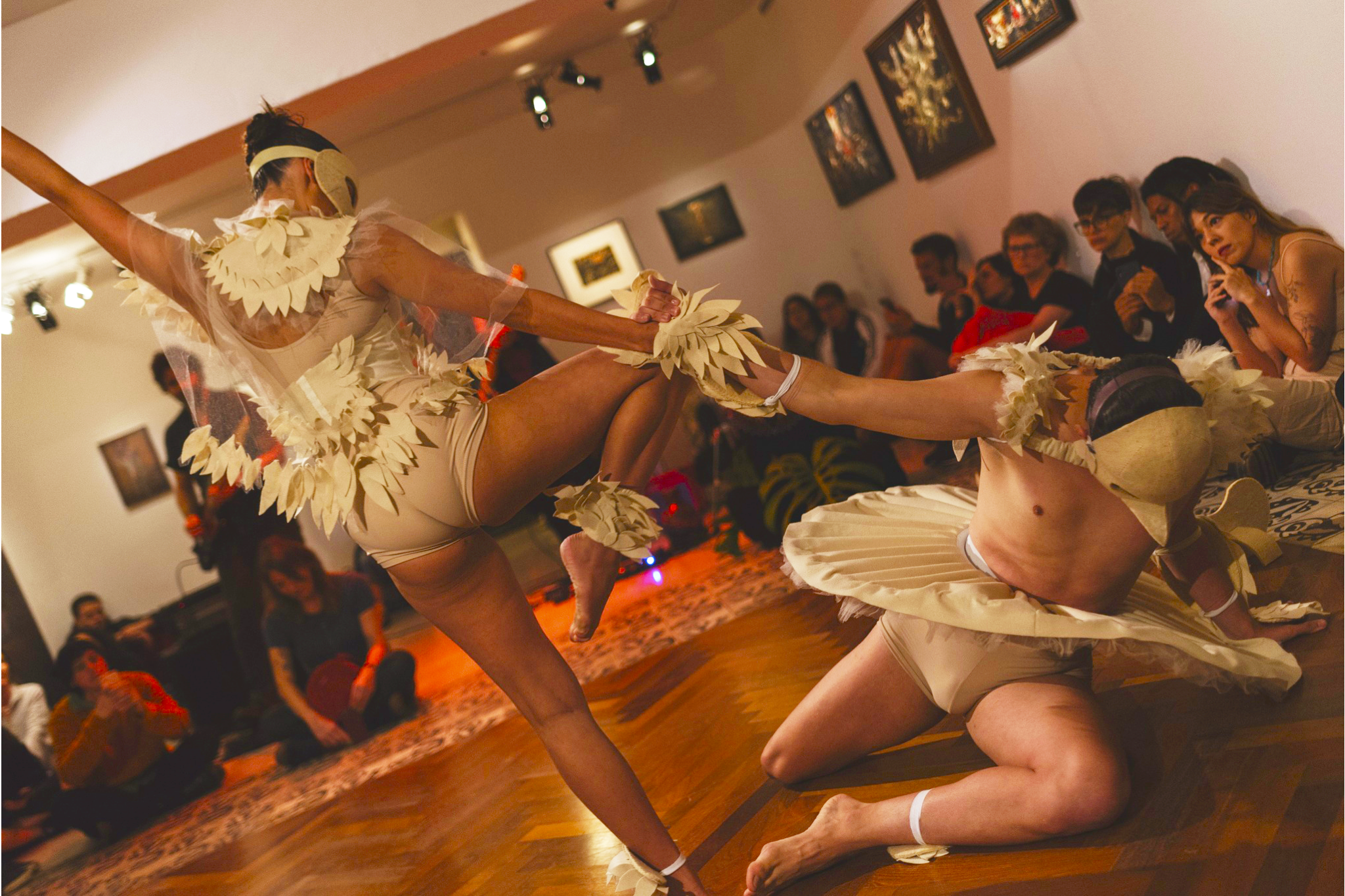
Last month, Haize attended the presentation of ‘Love Scene, Crime Scene’ in São Paulo — a three-part exhibition series by Brazilian artist Ana Mazzei centered around the fictional disappearance of a ballerina. Ana presented the third part of ‘Love Scene, Crime Scene’ in March at Green Art Gallery in Dubai, which remains on view until April 20th. We had the opportunity to speak with Ana about her creative path and the multidisciplinary artistic approach she employs in her work. This interview allows our readers to delve deeper into Ana Mazzei’s artistic universe.

Ana Mazzei is a multidisciplinary artist from São Paulo who skillfully explores the diverse realms of painting, sculpture, videos, and installations. Throughout her career, Ana has focused on experimental practices, integrating various materials such as cement, wood, felt, and cloth into her immersive environments.
Ana’s works are rooted in staging and arranging elements in front of the viewer. Each piece serves as a fragment of narrative, intertwining myths, lives, and imaginative fictions across different mediums. In her practice, diverse scenarios are brought to life through sculptures, drawings, photographs, performances, and installations that blur the boundaries between reality and imagination.

What mediums do you use in your practice?
As a teenager, I was fascinated by images and photographs, so I began my journey as a photographer. Through my experiences with photography, I developed a keen interest in arranging objects and people in front of the camera. I found myself directing people and positioning them in specific ways. This journey led me to create compositional backgrounds for my photographs, and eventually, I realized that this process of composing the image was the essence of my work. Consequently, I transitioned to creating three-dimensional and performance-based artworks.
How do you decide which medium to use whenever you create?
It depends on my mood and sometimes my curiosity about exploring a particular material more than others. When I feel I’ve mastered a specific material, I often feel compelled to try something new. That’s why my work encompasses various mediums—I work with wood, ceramics, bronze, performance, and more. I always seek different ways to express myself, constantly exploring new materials and techniques.
For example, after several years of not painting with oils on canvas, I recently decided to revisit this medium. I immersed myself in painting, and this body of work is what I’m currently preparing for the exhibition. Simultaneously, I’m collaborating with dancers on a performance piece. I’m constantly working and evolving, and I’m never quite sure what the next step will be. This unpredictability can sometimes pose challenges for gallerists, collectors, or curators, but to me, it’s not a problem—it’s a solution. It allows for ongoing growth and experimentation.

Where do you get inspiration from?
I don’t believe in inspiration. I view creativity as an ongoing process. I spend time in my studio every day, working and thinking. This involves creating drawings, engaging in extensive reading—particularly poetry—watching movies, listening to music, observing my surroundings, spending time in nature, and studying various art forms. I draw inspiration from theatrical scenarios for the projects I’m working on. It’s a blend of many influences rather than relying solely on one or two sources.
Could you explain/describe your creative process?
I’m unsure if it’s entirely explainable, but I typically find myself in the studio. Sometimes, I start by drawing, and from those drawings, I create prototypes. From these prototypes, I try to understand if they fit into a larger context, and then I decide on the material and see where it takes me. Other times, everything comes from an initial idea written in my notebooks, and I develop it further. However, I don’t have a fixed method—it’s not always the same process.
What remains consistent is my daily presence in the studio, as I practically live there. I’m there every day, even if I’m just organizing things or revisiting old drawings. Sometimes, I find inspiration from those drawings and use them to develop sculptures or other works. It’s a very organic process without a set method or specific subject in mind; instead, it’s an experimental approach.

What is your artistic research about? What would you like to tell your audience through your art?
I don’t engage in specific artistic research. My primary focus is creating a connection between the audience and the work, disrupting the conventional relationship with exhibition spaces, and establishing a unique environment with my art. It’s more about producing art in an abstract sense than pursuing organized research. While I relate to concepts like staging, composition, materiality, and the transformation of spaces through three-dimensional sculpture, I don’t center my work around a specific subject.
I’m not necessarily trying to convey a specific message through my art; rather, I aim to capture the audience’s attention. Understanding who is observing my work is crucial to me. Whether it’s an object or a performance, I approach my work with a focus on how it engages the viewer’s body and visual perception. This can involve elements such as color, texture, movement, sound, and even scent. I want people to pause, listen, watch, and immerse themselves in the details—to investigate. That’s why I feel a strong connection to theatre; it’s about creating an experience where people are captivated by the moment, taking in the lighting, music, voices, and everything happening before them. It’s about inviting them to engage fully with what is present. I consider the work successful if I can evoke a sense of connection and sensitivity in people.

What are you currently working on?
I’m currently immersed in a project called ‘Love Scene, Crime Scene,’ a long-term endeavor initiated about a year or two ago. The first part of this project was showcased in September at GB Agency in Paris, featuring installations, sculptures, and a video. The second part took the form of a performance in São Paulo, involving two musicians and two dancers. Now, with the third act, I’m presenting it in Dubai as an art show titled ‘How to Disappear,’ with paintings and sculptures. The paintings serve as evidence, creating a sense of mystery around the plot of my story.
This project revolves around the disappearance of a ballerina, and I’m crafting a mystery surrounding her vanishing. The ballerina’s ultimate fate and the story remain uncertain as I’m still developing it. I am still determining whether there will be two more parts or just one; it’s an ongoing exploration.

How did you develop the idea and choose the subject for the work ‘Love Scene, Crime Scene,’ and what does it mean to you?
My interest in crime stories and investigations inspired me to pursue this project. I began writing the story about a ballerina as a script, intending to present it in various formats: an exhibition, performance, and set to music. I chose to feature a dancer as the protagonist because I perceive her existence as a genuine connection with life; she embodies movement, body, and desire.
How much time did it take to build this work? What was the intention behind it?
It’s still in progress, but the initial part, a sculpture exhibition, took approximately six months of work. However, this varies significantly depending on various factors. Every new work presents a challenge. As mentioned earlier, decisions are made during the creative process and depend on my subjective will, which is challenging to explain.

Why are there three parts to your story, and what does each mean?
The project still needs to be finished; we’re currently in the third part, but I’m still determining how many parts there will be. The meaning lies within the work itself; there’s no definitive interpretation. The first part was more connected to a scene, the second to the body in motion and the music, providing a more tangible experience. In contrast, the third part consisted of traces and evidence of investigation. However, this understanding is optional.
How did you choose these three cities to present your work?
These are cities with which I have long-standing relationships. São Paulo is my hometown, where I currently reside. I lived in Paris previously and was invited to exhibit my work there, and a gallery in Dubai also represents me.
Did you have to adapt your artwork for different audiences due to cultural differences?
No, I have never encountered any issues related to cultural differences.

What were the most remarkable projects and exhibitions that helped you shape your artistic identity and gain recognition?
Several projects stand out to me. One is the installation sculpture project I created for the São Paulo Biennale in 2016. It was a significant endeavor as it was the largest project I had undertaken at the time, comprising numerous pieces. Another notable project for me took place at a São Paulo community center. This project spanned over six months and involved a combination of performances and sculptures. Despite facing various challenges throughout the process, I overcame them, making the project particularly meaningful to me.
When I participated in exhibitions such as the São Paulo Biennale, the Biennale in Ecuador, the Biennale in Uruguay, and the Glasgow Biennale, each of these experiences were crucial in shaping my artistic identity and establishing a presence in the art world. However, I’ve found that smaller, independent exhibitions in unconventional spaces have also played a significant role in my development as an artist and creator. The impact of these exhibitions went beyond commercial success, influencing my artistic philosophy and thought processes. Measuring their importance is challenging, as sometimes the value lies more in personal and creative growth.
I believe that emerging artists don’t necessarily need a high-profile exhibition curated by someone else to make an impact. What’s crucial is finding a platform, whether a small garage show or a major museum exhibition, where you can authentically present your work. Aspiring artists should be willing to stand for their beliefs and showcase their creations wherever they can. It’s a gradual process, and the journey matters as much as the destination.
On April 4th, she will showcase her next exhibition, ‘The Disagreement: The Theater of Statements,’ at Neuer Kunstverein Vienna alongside 11 contemporary Brazilian artists. We highly recommend those in Vienna to attend the exhibition and delve deeper into Ana Mazzei’s creative universe.