Cart 0
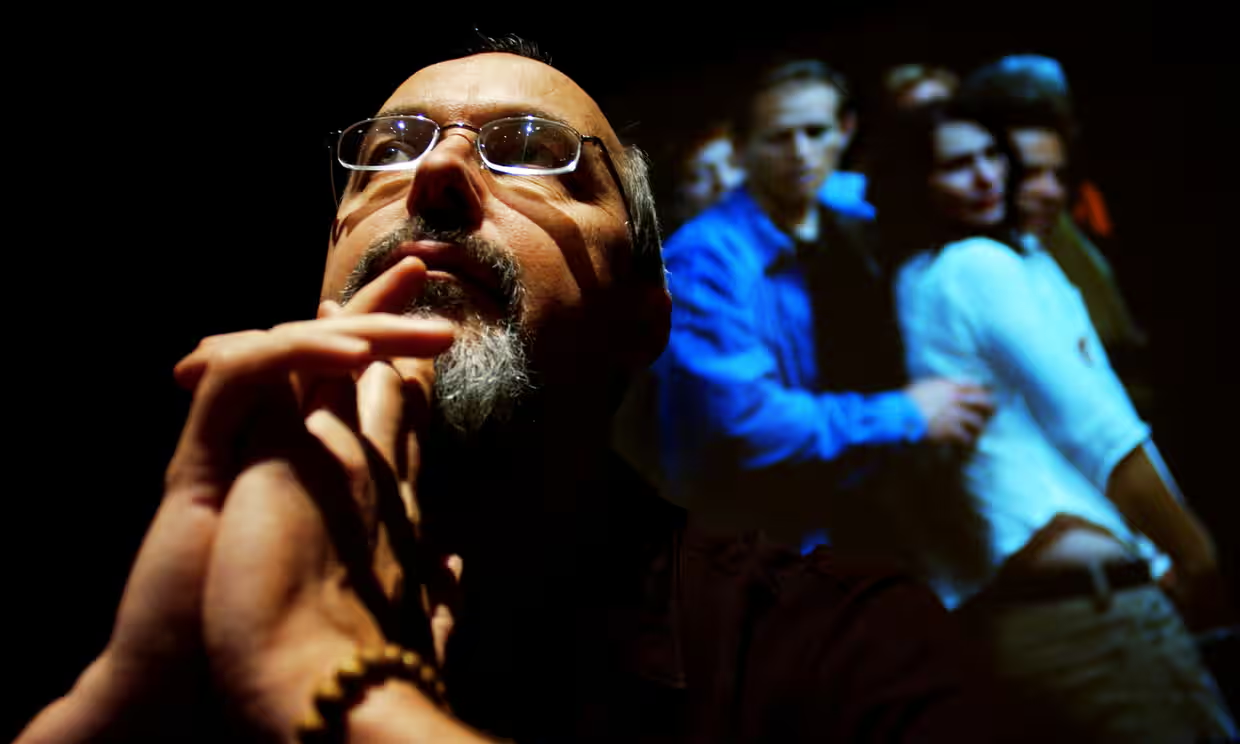

The art world mourns the loss of Bill Viola, a pioneering artist who elevated video to a vital form of contemporary art, expanding its scope in terms of technology, content, and historical reach. He passed away on Friday, July 12, at his home in Long Beach, California, at the age of 73. Kira Perov, his wife, studio director, and artistic collaborator, reported that the cause of death was complications from Alzheimer’s disease.
Viola was one of the most influential and celebrated video artists of all time, bringing a timeless sense of beauty and age-old spirituality to the medium. His works centered on universal human experiences—birth, death, and the unfolding of consciousness—with deep roots in Eastern and Western art and various spiritual traditions. He drew inspiration from multiple sources, including Buddhist, Sufi, and Christian religions, blended with a foundation of universal humanism. Viola played a central role in establishing video as an essential form of contemporary art, significantly broadening the medium for future generations of artists. In a 2007 lecture, he said, “I see that media technology is not at odds with our inner selves but, in fact, a reflection of it.” Let’s meditate on that, shall we?

In the early 1970s, when other artists were just beginning to explore the new medium of video, Viola had already earned a reputation as a technical wizard adept at recording and editing methods. He gained experience in technology through jobs as an audiovisual assistant in museums and galleries. Many of his early works reflected a fascination with special effects, including input-output feedback loops that filled screens with visual distortions. Since the 1970s, Viola created videotapes, architectural video installations, sound environments, electronic music performances, and works for television broadcasts—all of which expanded the scope of the medium and established him as one of its most notable practitioners.

Viola’s influence was not limited to his solo work. Across five decades, he frequently collaborated with other artists and musicians—from Frankfurt’s Ensemble Modern in 1994 and the industrial rock group Nine Inch Nails in 2000 to director Peter Sellars and conductor Esa-Pekka Salonen on a new production of Richard Wagner’s Tristan und Isolde, which toured internationally from 2004.

Viola’s popularity extended beyond the art world, as his work appeared in unexpected places. He was commissioned for the 2004 Olympics in Greece, where he produced The Raft. In 2012, Viola and his wife, Kira Perov, traveled to El Mirage Dry Lake in the Mojave Desert of California to record Crossroads, a massive installation for Hamad International Airport in Qatar. In 2014, he completed the first of two video commissions for St. Paul’s Cathedral in London, marking the first permanent video art installations in a Church of England cathedral.

Viola wrote in 1989: “I have come to realize that the most important place where my work exists is not in the museum gallery, or in the screening room, or on television, and not even on the video screen itself, but in the mind of the viewer who has seen it.” The artist couldn’t have been more accurate; some of us are still inspired by the magical, time-bending experience of visiting his last exhibition, “Sculptor of Time,” at the museum La Boverie in Liège.
Viola’s influence was recognized internationally with awards and retrospectives. In 2017, the Guggenheim Bilbao Museum presented Viola’s works from 1976 to 2014, attracting more than 700,000 visitors.
Viola passed away on July 12 at his home. He is survived by his wife, Kira Perov, his sons, Blake and Andrei Viola, and daughter-in-law Aileen Milliman. Haize extends deep condolences to Viola’s family, friends, collaborators, and fans around the world.